
ADHD or Bipolar Disorder? Understanding the Overlap (and Why It Gets Missed)
It's 1 a.m. and you're six tabs deep into researching how to start a sourdough business. You've already reorganized the pantry, sent your best friend a four-minute voice memo about it, and ordered a proofing basket. Two weeks later, the starter is dying in the back of the fridge and you can barely drag yourself to answer an email.
So you do what we all do. You Google it. And the internet hands you two very different answers: ADHD or bipolar disorder.
If you've landed here, you're in good company. These two get confused all the time, even by professionals, and plenty of people live with both. Let's walk through where they overlap, where they split, and why getting the full picture can change so much.
A lot of this builds on Dr. Megan Anna Neff's thorough breakdown, ADHD vs. Bipolar Disorder: Differences, Overlap, and Misdiagnosis, plus the research linked throughout.
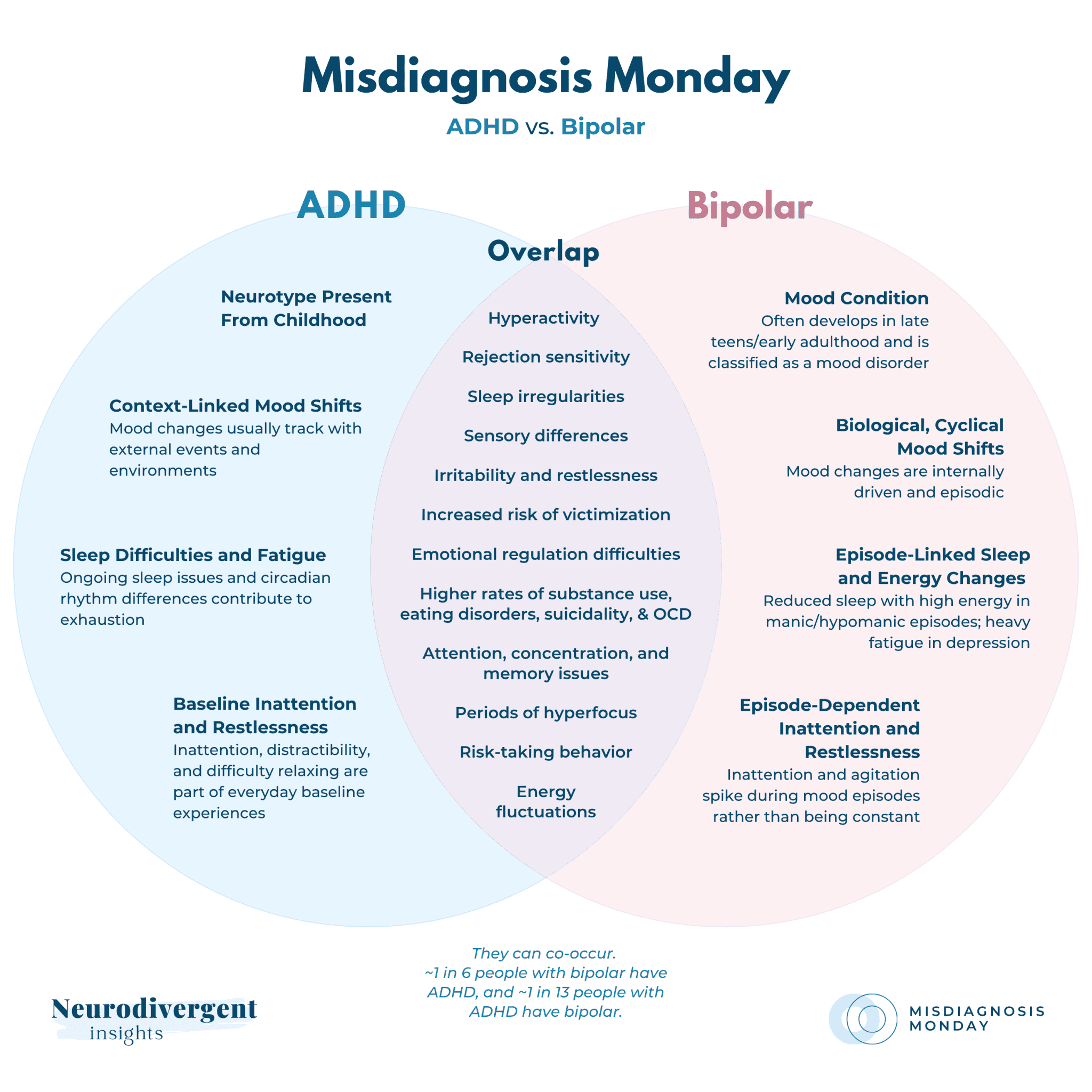
Image by: Dr. Megan Anna Neff
Why these two get mixed up
Here's something nobody tells you about ADHD: it isn't only about attention. For a lot of adults, the hardest part is the feelings. Big ones, fast ones, ones that hit like a wave and then disappear. A 2014 review in the American Journal of Psychiatry found that emotion dysregulation shows up in ADHD across the lifespan and is one of the biggest reasons daily life feels so hard.
That emotional intensity isn't on the official ADHD checklist, though. So when an adult tells a provider "my moods are all over the place," ADHD can get missed and a mood disorder gets written down instead.
Bipolar disorder is built around mood episodes: stretches of mania or hypomania and stretches of depression that feel noticeably different from your usual self. ADHD is different. It has been part of you since childhood, and the DSM-5 looks for symptoms before age 12.
Clinicians have been waving this flag for years. Asherson and colleagues warned that adult ADHD can look like bipolar disorder, often shows up alongside it, and that mixing the two up can lead to a care plan that just doesn't fit.
Wait, can you have both?
Yes, and it's more common than you might think. A 2021 meta-analysis pooled 71 studies covering more than 646,000 people across 18 countries. Here's what the researchers found:
Roughly 1 in 13 adults with ADHD also has bipolar disorder.
Roughly 1 in 6 adults with bipolar disorder also has ADHD.
When both are present, bipolar symptoms tend to start almost four years earlier.
The authors concluded that the two show up together far more often than chance would explain, and that clinicians should screen for both. As Dr. Neff points out, the bigger problem may not be getting the wrong diagnosis. It's getting only half of the right one.
Where ADHD and bipolar disorder overlap
If you drew a Venn diagram, the middle would be crowded. Here's what the two can share, and what it might look like in real life.
Big mood swings. One minute you're on top of the world about a job lead. The next, a vague "we need to talk" text has you spiraling. Mood shifts happen with ADHD and with bipolar disorder.
Energy that won't quit. Talking fast, bouncing your leg through an entire meeting, feeling like your body came with its own motor. That can be ADHD hyperactivity, or it can be mania or hypomania.
Lots of starts, not many finishes. The half-knit scarf, the podcast you're definitely launching, the guitar in the corner. An interest-driven ADHD brain loves a new idea. Mania can also bring a burst of starting everything at once.
Impulsive choices. The online cart you don't remember filling. The last-minute road trip. The thing you said before your brain caught up. Both conditions can include impulsivity.
Brain fog and feeling stuck. Staring at a task you know how to do and just... not doing it. That's classic ADHD executive dysfunction, and bipolar depression brings its own heavy fog. Some people with bipolar disorder keep having attention and memory struggles even between episodes.
Messy sleep. Late-night scrolling, a brain that won't power down, waking up wrecked. Sleep trouble is very common with ADHD, and a sudden drop in sleep is a hallmark of mania.
Rejection that hits hard. If a friend's slow reply can wreck your whole afternoon, you might know rejection sensitivity. It's strongly tied to ADHD, and research summarized by Dr. Neff suggests people with bipolar disorder can be more sensitive to rejection too, especially during depressive episodes.
How to tell the difference
None of this is a do-it-yourself diagnosis. Think of these as the questions a good clinician will get curious about with you.
Has it always been this way?
This is the big one. ADHD is your baseline. Your third-grade teacher probably noticed it, your college roommate definitely did, and it shows up at home, at work, and in relationships. Bipolar disorder comes in episodes: stretches of time that feel different from how you usually are, with a beginning and an end.
A 2016 study of adult women with ADHD, bipolar disorder, or neither found the two could usually be told apart by pairing a detailed interview with a close look at timing. Were the mood symptoms steady and trait-like, or did they arrive in distinct episodes?
What set it off?
ADHD moods usually come with a "because." Because your boss critiqued your work in front of everyone. Because the grocery store was loud and bright and you forgot your list. The feelings are real and intense, and they often settle once the situation changes. Bipolar episodes tend to come from the inside. They may not have a clear trigger, and they usually last days or weeks, not hours.
How are you sleeping, and how does it feel?
With ADHD, a short night usually costs you. You're foggy, cranky, and running on cold brew. During mania, someone might sleep two or three hours and feel incredible, with no sense of needing more.
What does the energy feel like from the inside?
ADHD energy tends to feel familiar, like excitement or restlessness you've known your whole life. People often describe manic energy as different: harder to steer, uncontained, and sometimes scary.
Does this still feel like you?
ADHD impulsivity is often about not hitting pause in the moment. You didn't think it through, and you might cringe about it later. During mania, people can act in ways that feel far outside their values, often with a sense of being invincible or unusually important.
Are there signs that only belong to one?
Distinct manic episodes, a sudden inflated sense of self that's out of character, and in some cases hallucinations or delusions point toward bipolar disorder. A lifelong story of lost keys, missed details, and dreading boring tasks since grade school points toward ADHD.
When the answer is "both"
For some people, the honest answer to "ADHD or bipolar?" is "yes." That same 2021 meta-analysis found bipolar symptoms started earlier when ADHD was in the picture, and Dr. Neff's review of the research notes more frequent mood episodes and higher rates of anxiety and substance use.
If that sounds like you, you may have spent years wondering which parts are "just your personality," which are ADHD, and which are mood. Untangling that isn't about collecting labels. It's about finally understanding your own patterns so you can get support that actually fits.
What a thorough assessment looks at
If you're wondering where you land, a good evaluation usually covers:
Your whole story. When did this start? What were you like as a kid? Old report cards and family stories can be surprisingly revealing.
Patterns over time. Tracking mood, sleep, and energy for a few weeks can show whether shifts follow your circumstances or roll in like weather.
Family history. Both conditions run in families, and relatives of people with bipolar disorder are more likely to have ADHD.
Screening for both. Researchers recommend checking for bipolar disorder in adults with ADHD, and for ADHD in adults with bipolar disorder.
Everything else in the mix. Anxiety, trauma, substance use, autism, and sleep disorders can all change how ADHD and mood symptoms show up.
You're not "too much"
So many adults we meet were told for years that they were too much, lazy, or dramatic before anyone looked closer. If that lands for you, hear this: struggling doesn't mean something is wrong with you. Your brain has been working overtime in a world that wasn't built for it.
Getting clear on whether you're working with ADHD, bipolar disorder, or both lets you stop blaming yourself and start building a life that works with your brain. In therapy, that can look like mapping your patterns, catching early signs of a mood shift, building routines that support focus and sleep, working through the grief of a late or missed diagnosis, and helping your partner or family understand what's really going on.
If you're struggling right now
Both ADHD and bipolar disorder are linked to a higher risk of self-harm and suicidal thoughts. If you're having thoughts of hurting yourself, please reach out now. In the U.S., you can call or text 988 to reach the Suicide & Crisis Lifeline, or go to your nearest emergency room.
Work with Snow Lake Counseling
Our Logan Square team specializes in neurodivergence, including ADHD and late-diagnosed adults, and we'd love to help you make sense of your story. We accept Aetna, Cigna, BCBS, and United, and we offer sliding scale sessions with our associate clinicians.
Schedule a consultation and come thaw things out with us.